Friday, 6 April 2018

PC Game Review: Fallout 4


GAME: Fallout 4
DEVELOPER: Bethesda Game Studios
PUBLISHER: Bethesda Softworks

YEAR: 2015

Disclaimer: All of the screenshots are using mods.

It's kind of hard to imagine but it's already been 3 years since Bethesda's official sequel to Fallout 3 finally released, to somewhat mixed reviews, except my own. I guess I've needed this much time to truly make up an opinion on the game to be honest, and in my opinion, Fallout 4 does improve immensely on its predecessor in a lot of ways, but also still brings on a lot of the same problems that typically plague Bethesda titles. But before getting ahead of myself, let's discuss Fallout 3 for a bit since it's impossible to talk about Fallout 4 without mentioning Fallout 3 and a little about the franchise as a whole...

Fallout 3 was a game that was, most of the time, at odds with itself. It wanted to be a RPG but compared to the earlier Fallout titles was fairly simplified to the point a lot of perks didn't matter that much, traits were done away with entirely and SPECIAL points didn't really matter as much anymore, putting you in a position where having a single point in a SPECIAL attribute would inconvenience you, sure, but it wouldn't outright cripple you like in Fallout 1 and 2. While this did make it a more player-friendly experience, it also made it impossible to make characters with serious disadvantages.

It also wanted to be a FPS but the combat system employed a fair bit of randomness (in an attempt to add realism I would assume, or just as an RPG gimmick), resulting in the player being unable to hit something despite aiming dead center at it. A higher Luck skill would improve this somewhat, but even at medium Luck it would make it at times really frustrating to play the game. The game also lacked ironsights, sprinting, and the FPS mechanics were so barebones it didn't really feel all that satisfying.

*cue badass music*
Despite this, I would be a liar if I said I didn't like it. In fact, I love Fallout 3 and I've spent countless hours with it. But it has a lot of grievances, specifically in terms of plot. It has a very clear cut "bad guys" faction and "heroes" faction, without taking into account that in earlier games the Brotherhood of Steel was practically a secretive cult that rarely or never seeked contact with outsiders, making their entire presence in the Capitol Wasteland highly questionable. It was also a highly linear story, making any player choice regarding story events miniscule, forcing you to pretty much do things that could potentially be out of character for you. Calling it clumsily written is an understatement.

Thankfully, in my opinion this is where Fallout 4 improves the most, although in all honesty the story is almost verbatim the same as Fallout 3's, except the roles are switched. Where in Fallout 3 you're a child searching for your parent, in Fallout 4 you're a parent searching for your son. I mean... not exactly being original there, Bethesda... But at least it has a lot of improvements. For one, it doesn't try to set up too many relationships during the intro sequence which is thankfully a lot shorter than Fallout 3's. It sticks to the core, the family, setting up your relationship with your spouse and your son before throwing you into the nearby vault when a nuke nearby goes off. As it turns out, this vault is actually a cryogenic storage, and you're chosen to be frozen for an indefinite amount of time. During your time being frozen the vault is broken into by an unknown person who kills your spouse and takes your infant son. You wake up again later and this is your main quest. Finding the asshole who killed your spouse and finding your son. It's dead simple but it works wonderfully as a setup and doesn't go into too much detail, making it much less of a chore to get through for players like myself who create a lot of new characters.

*sniff* Did someone fart?
And it also foregoes the "good vs evil" mantra of Fallout 3 entirely. Instead of having a good and evil faction in the game, it has 4 main factions, and it's largely up to the player to judge whether they are good or evil, but all of them clearly has their own convictions and their actions can be good or evil depending on your viewpoint, because it is clear that all of the factions have good intentions. It's insanely refreshing to see this juxtaposed with Fallout 3's contrived scenario of Brotherhood of Steel vs Enclave. It's also less focused on strictly good or evil actions, and some of the side quests have morally grey areas where you might not be sure what is morally correct to do (though never to any extreme extent that I can remember). It poses questions like "can machines be considered human", "are the Brotherhood of Steel truly the saviours" and what you will do when you find out who your son is. So all in all it's probably the best story I've seen in any of the Bethesda released Fallout games (and yes, that includes New Vegas, sorry for all you New Vegas lovers out there). I actually did connect very well with the main character and was on a pretty emotional rollercoaster for most of the game and I loved it. It's really well done compared to the dud that was Fallout 3.

Companions have also been fleshed out a lot more compared to Fallout 3 and also made invincible so that they cannot be killed (which I am HUGELY grateful for...), only downed in which case you can stimpak them to get them back up. They're also given way more personality, given more proper backstories that are revealed to you as you talk to them over time, and also give you unique quests, in which you can assist them to gain their loyalty (a note taken from Mass Effect that I like). They're also a lot less 2-dimensional than the companions in Fallout 3 which were usually, well, pretty one-sided and would pretty much judge the character based on their current karma level. And sure, these companions will judge the player based on their actions too but it's less because of them being good or evil characters and more because of their own convictions. It's also possible to romance some of them, giving you a permanent perk, and this is NOT restricted by gender either.

DAMNIT, DOGMEAT! Get out of the damn way!
Of course, how can I forget the most important part of the story, Dogmeat... Dogmeat has been way more fleshed out in Fallout 4, given its own unique dog model (modeled after a real life German Shepard, although a female one, nice bit of trivia for you) and playing a much bigger part in the story than he did in Fallout 3, leading some of the major plot points in the story and serving as the first companion you come across that can be hired. He's also unique in that he follows the player regardless of their actions and will always remain loyal to you. Though at times he can be a bit of a nuisance, sometimes getting a bit "up in your face" and such though this really counts for all of the companions in general...

So with the story bits out of the way, let's get into the gameplay. Where Fallout 3 felt at odds with itself, Fallout 4 feels more like it has less of an identity crisis and knows what it wants to be. It has much smoother combat and the VATS system has been changed to not stop time and only slow it down (which feels a lot more believable in my opinion), making it feel less like a remnant from when the games were turnbased and more like the character being imbued with faster reflexes. The FPS elements take more of a center stage, adding a sprint button, ironsights, leaning and generally feels a lot less clunky to play. The game also adds weapon mods into the mix, allowing you to craft and add weapon attachments and upgrades to your guns, sometimes allowing you to do as much as upgrading a pistol to a sniper rifle depending on the parts you choose to install. In all honesty, it feels like playing Fallout 3 with the mods that made it actually playable, and even going a step further from there.

You know... I may have to lay off the irradiated water when I start seeing flying ships with rocket engines...
This also ties into the RPG elements. Instead of trying to be a RPG and kind of failing at it, well... the bad news is it still fails completely at being a true RPG, but what I mean by "less of an identity crisis" is that the RPG elements now feel like that. RPG elements. They're not so much an essential part of the game anymore and now play more of a "choice" role in the game, allowing you to choose which kind of character you want to play in a lot more shallow sense. There's no deep choices, it's downright impossible to make a flawed character and thus the roleplaying aspect has been even further dumbed down from Fallout 3. But here's the thing, this is only a bad thing if you EXPECT a RPG out of Fallout 4. If you expect a FPS with RPG elements then that's what you'll get and you know what? I'm fine with that. I'd rather have a game that KNOWS what it wants to be than a game that tries to be two things and fails at both. Fallout 4 feels way more cohesive in terms of gameplay design as a result of this and while I can totally agree this might not be the direction the series should go in, it doesn't necessarily make Fallout 4 a bad game, but it makes it less of an RPG than Fallout 3 and especially Fallout 1 and 2 which I wouldn't even consider in the same genre anymore.

The most notable change from Fallout 3 is undoubtedly the removal of the karma system. In Fallout 3 the karma system was a carryover from Fallout 1 (in Fallout 2 there was less of a karma system and more of a general reputation system reflecting less bad vs good and more reactions from people to your actions), and made the game unnecessarily focused on extremes. You either had to play a saint or a mass murdering psycopath, creating an intense disconnect at times where there was no middle ground to choose. Fallout 4 drops this entire idea in favour of a system where you're either altruistic or self-serving, focusing less on being good or evil, and more on whether you think people are worth your time or not. I will admit I kind of prefer this as your player actions flow much better and you're never in situations where you could have nuked Megaton for instance and then given water to a beggar until you were the saviour of the wasteland. Fallout 4 also gives you a lot more choices regarding the main quest and your actions have lasting impact on the outcome of the game, though it never feels like you're doing something evil, but something you believe is good but that WILL have consequences.

A possible hobby in Fallout 4: Maintaining power armor.
Another huge aspect about the gameplay is undoubtedly the crafting and the building and managing of settlements. And pretty much the entire game plays into this aspect as well. Garbage that used to be, well, garbage, now has an actual use as you can now use it for crafting materials to craft everything from gun parts to armor and even entire buildings, giving you much more incentive to loot the places you raid for vaulable trash (something the companions annoyingly will constantly get on your ass about as they seem as oblivious as ever to the fact trash is actually useful in this universe). It can be a HUGE timesink to build and improve settlements constantly and create trade routes between them. It's almost its own little minigame within the game and gives you plenty to do when you're not out looting and raiding outposts. What I love about it though is that this is never really important in the game and it is up to you how much you want to get involved with it. It also feels like the game world is a lot more dense than Fallout 3's world and there's a lot to explore and see, and it doesn't feel like as much of a drab wasteland as a result, giving way more incentive to actually walk around than fast travel everywhere, and I kinda love that it makes exploration itself a lot more interesting.

Power armor is also treated very differently in Fallout 4 compared to earlier games. Where in earlier games it was pretty much just a really powerful armor that required special training to use, in Fallout 4 you can (somewhat inexplicably) use any power armor without much special training and it's treated more like a vehicle that requires power cells to be used effectively. Of course, you can customize it with custom paint jobs, changing out parts, giving it special enhancements and upgrade the hell out of it so even if it does at times feel completely at odds with how power armor was established in the franchise, it's still interesting to see power armor be given more of a unique position in the game in its own way.

The dialogue system has been a bit of a controversial topic regarding the game as the amount of choices has been limited to 4 categories of answers, similar to games like Mass Effect. An inquisitive response at the top, a negative response at the right, a neutral response to the left and a positive one at the bottom. Mods have been released that make the dialogue system more like the old games though, if this is not to your liking. Having played a ton of Mass Effect and understanding that the game doesn't really wish to be a true RPG I didn't and still don't mind this system much personally and never got too worked up about it. I mean, yeah, it's not really giving you much flair to your options but considering your character is voiced in this game and considering its focus, I am completely fine with it. I also think overall the conversation system is HUGELY improved over earlier titles where conversations would freeze time and have you simply standing still with a person as you talked to each other, making conversations feel entirely static. In this game, people will still do things around you as you talk, conversations can be interrupted and you can walk around as you talk, and the camera feels a lot more active and dynamic too, making conversations feel much more "alive", especially with your character finally having a voice as well.

Of course it's worth mentioning that much like Fallout 3 and New Vegas the mod scene for Fallout 4 is as active as ever, despite Bethesda's continued attempts at stopping modders from adding free content to the game and completely refusing to work with the mod scene in any helpful way, even going as far as launching their own mod store and trying to monetize what is essentially free on PC. Bethesda's recent attitude towards the mod scene really has to be mentioned as pretty appalling and it disgusts me that they treat modders with such contempt when they are practically the people who keep breathing life into their games. Anyway, there's probably a lot more about the gameplay I could go into detail about but I think I've covered the broad strokes of it and what I wanted to comment on.

To be fair, I've woken up with my pillow like that too.
Graphically the game definitely is a massive improvement once again. It foregoes the somewhat drab and monotone hue of Fallout 3 and goes for a far more colourful palette (something that I instantly noticed when the game was revealed and had me sighing in relief). It also has a graphical style all of its own, going for less of a rusted decrepit look and more of a colourful look. It may stretch the suspension of disbelief a little that things would look this pristine after so much time has passed, but it does make the game look rather gorgeous. Of course, facial animations are improved but still fairly janky and a lot of characters still have this dead eyed stare about them, giving quite the uncanny valley effect a lot of the time. I mean, it doesn't really bother me enough to not play the game but it IS noticable and worth commenting on. The game also runs fairly well on my system on fairly high specs, but does stutter a fair bit, especially in areas with a lot of detail such as urban areas. I honestly can't wait to get a new PC so I can truly pump up the graphics to ultra settings without sacrificing all that much framerate, especially in these areas. Of course, there exists mods like ENB that adds a lot more graphical options to the game and can make it look even more gorgeous, as well as texture mods to enhance the game's textures further, so if you're not happy with how the vanilla game looks there are ways to customize it more to your liking. I will admit though that compared to Fallout 3 which I find impossible to play without several graphical mods, Fallout 4 looks a lot more presentable out of the box.

The music is mostly forgetable sadly, most of it falling into the same trap as most modern AAA game music and just sounding like background noise. And while the radio stations offer up some variations with some classic oldies, it does get fairly repetitive after a while. The voice acting is pretty good for the most part, with props going to the protagonist voice actors who do a pretty good job voicing the protagonist of the game. I did notice some voice actors from Mass Effect here though, like the voice actor for Garrus who pops up in several minor roles, and the voice actor for the companion Caite would go on to voice a character in Mass Effect Andromeda (which I am getting around to reviewing eventually...). Together with the dialogue system and companion loyalty missions and romance system I can't help but feel like Fallout 4 is more of a spiritual first person Mass Effect sequel than a Fallout 3 sequel, in all honesty. Not that I mind...

I guess the roach found some armor...
So all in all, what do I think of Fallout 4? I mean, yeah, it's hardly a RPG series anymore, and it still has a fairly linear story and not much room for actual roleplaying and playing a flat out bad guy is still impossible. And you STILL cannot become a pornstar or use sex to persuade people. But in all honesty, none of these things would actually FIT in Fallout 4 because it has a much stronger vision of what it wants to be than Fallout 3 which had much stronger ties to the older games (in all the wrong ways though). All in all I consider Fallout 4 an excellent game, but not an excellent RPG and not an excellent Fallout game. It is what it is, take it or leave it.

STORY: 8/10
GAMEPLAY: 9/10
GRAPHICS: 8/10
SOUND: 6/10

TOTAL SCORE: 8/10

Sunday, 1 April 2018

Build Engine Retrospective Part 1: Duke Nukem 3D


GAME: Duke Nukem 3D
DEVELOPER: 3D Realms
PUBLISHER: 3D Realms
YEAR: 1996


When it comes to first person shooters, the most groundbreaking games in the genre undoubtedly came out during the 90's. This time period was truly the golden age for the genre, releasing a ton of classics in the genre that laid the groundwork for much of today's titles in the genre. Wolfenstein 3D started it all but then we got titles like Doom, Rise Of The Triad, Blake Stone and eventually a game would come out that really carved its own unique place among other so-called "Doom clones". With its groundbreaking engine, impressive amount of interactivity and one-liner spouting titular action star protagonist, Duke Nukem 3D managed to create quite a few ripples in the gaming community despite the incoming Quake which would make its technology look a generation behind in comparison. So today on my blog I'm starting a new series called Build Engine Retrospective where I'm taking a look at games that utilized the now legendary Build engine, many of these released in the years between 1996-1998. What these games often share in common is a unique theme, scripted events and a ton of other features that for the time and given the limitations of the engine make them quite memorable to play even today. And I'm starting with the first commercial game to utilize the Build engine, the king himself, Duke Nukem 3D.

I practically grew up with Duke Nukem so the character holds a very special place in my heart. The very first game I remember ever playing was the very first Duke Nukem, an EGA platformer for DOS that was a really popular shareware title around '91. Already then Duke Nukem was established as a gun-toting badass who was Earth's only hope. In the first game he went after the evil Dr Proton and his army of Techbots, and while his personality was a bit derivative and referencing pop culture like watching Opera Winfrey show, it wasn't until Duke 3D his personality as a woman-loving pill-popping ultra-macho amalgation of 80's action heroes came into play. And in a way, Duke grew up with me. When Duke 3D came out I was about 8 years old and just about to enter my teens and with Duke 1 being my first game, it felt as if the character had grown up with me. I was always interested in a lot of typical boy stuff at that age, watching a lot of movies that I wasn't allowed to, playing games I wasn't allowed to and generally showing more and more of an interest in the kind of masculine entertainment that there was a lot of when I grew up. And a lot of it really influenced my tastes and shaped me to be the person I am today. I of course also liked feminine stuff, I hung out with other girls a lot, played with dolls and did all of that stuff, but I was also into guns and shooters and such things, and always have been. And something about the Duke Nukem games almost embodies all of those core interests. There's a dystopian and almost cyberpunk future feel to the games, and this carried on very well into Duke 3D although it has a distinctly more realistic feel than the first two games.

I can't let you rip off that movie, Duke...
The story is pretty simple. After returning to Earth after defeating the aliens in Duke 2, Duke finds that another alien race has wiped out most of Earth's population and taken most of our women, and turned all the police into pigs. His mission becomes to wipe out most of the aliens on Earth and take the fight to their mothership in space, culminating with a battle with the one-eyed commander of the entire fleet and the alien queen in a bonus episode called The Birth.The story never takes itself seriously, with Duke at one point saying he'll shit down a boss' neck after killing him. And promptly does so. So yeah, it's not a huge story or anything but it's funny, works for setting the game's derivative tone and there's nothing really bad I can say about it.

What really set Duke 3D apart from its contemporaries such as Doom and Quake was its environments. Up until that point, levels in shooters were often very abstract and maze-like. Duke 3D's levels on the other hand almost had a bit of an open world feel to them and were often much more urban in nature, giving them a very realistic feeling. They felt like locations that could potentially exist in real life as you moved through buildings, underground tunnels and visited everything from brothels and strip clubs to a burger restaurant. Of course, all of the levels still have an exaggerated look to them and feel like something out of an action movie, but compared to the levels of Doom for instance, the difference is night and day. The exception of this is obviously the second episode which takes place in space and has more of a Doom-like sci-fi influenced level design that pays homage to H.R. Giger's Alien environments among other things.

Episode 2 features some pretty cool sci-fi esque levels.
The game really does feel like an homage to the 80's and 90's, with its plentiful references to everything from Aliens, Evil Dead and They Live to OJ Simpson's car escape. It ends up feeling a little dated but in today's nostalgia-driven retrowave culture it still holds a lot of appeal and it's easy to see why this game continues to be so influential to a lot of modern oldschool shooters. Control-wise it was pretty ahead of its time allowing for not only mouse aim but also remapping the movement keys to WASD makes it feel surprisingly modern in terms of controls. It even allows for jumping and ducking (which was actually a fairly new idea at the time). Another new idea it added was an inventory with different items, which could be activated at your leisure and adding some tactics to the game in when you used these items. The idea of an inventory would be used again in several other Build games, often copying Duke's item selection, which consists of a portable medkit (which can be used to heal up to 100 health points), Night Vision goggles (that really don't work as you'd expect, they mostly just put a green filter on the screen and make enemies into glowing green figures), Boots (give protection against acid, lava and other harmful substances), Steroids (pretty much turns you into Sonic and I think they give you additional melee strength), and Scuba Gear (lets you breathe under water). The final one is the Holoduke, which I probably end up never using as it is far more useful in multiplayer matches than single player. It projects a fake version of the player but most of the AI simply doesn't give a fuck about it.

Dem titties! Shake them!
The weapon selection is also pretty classic but also has some guns that are pretty unique to Duke 3D itself. You have the expected Doom-style loadout with the melee (Duke's mighty foot), pistol, shotgun, chaingun and rocket launcher, but then we get into the somewhat more iconic weapons. The pipebombs are throwable grenades that explode when you click the button a second time, meaning they explode exactly when you want them to which is perfect for not only getting rid of badguys but also blowing up parts of the environment to reveal secret areas You then have the shrinker which does what it says on the tin, it shrinks your enemies to action figure size and allows you to step on them. Of course the reverse is also true and if you get hit with a shrinker beam you yourself become tiny and will have to watch out for enemies stomping on you. The Atomic Edition also adds the Microwave Expander, a gun that does the exact opposite, blowing up your enemies literally until they explode. You then have the Devastator, a really powerful dual rocket launcher that fires miniature rockets at a high fire rate. It's probably my favourite weapon in the game and fits its name as it makes short work of most enemies in the game sans bosses and larger enemies, but its major caveat is that it burns through ammo like a fat guy through a donut shop. You then have the laser tripmine which is pretty good for multiplayer matches but like the holoduke rarely comes into play in single player. Finally you have the Freezeray, which freezes enemies and allows you to break them easily with a kick or fire from any of the projectile based weapons. It creates this unique tactical combat where some of the weapons give a basic combo attack, like the shrinking and stepping on enemies, or freezing and shattering them. I can't really think of any shooter at the time who had this kind of combat.

Can't a man enjoy a flat martini and a looping animation in peace?
As varied as the guns are, so is the enemy roster. You have your basic grunts, the assault troopers who do little more than shoot lasers at you though some of them have the ability to temporarily teleport out of experience before appearing behind you. Some of the may even fake their death (if you see them going into their choking animation upon death there is a chance they will get back up again). You then have the iconic pig cops, who wield shotguns and take a little more damage before going down. After that you have the Fat Commander (officially called the Assault Commander), a flying slob firing rockets out his ass while grunting "suck it down". They can be a right pain in the ass but using the shrinkray on them makes them surprisingly easy to kill (a trick that also works well in Duke Nukem Forever). In addition to these you have the larger enforcers who shoot chainguns at you, and the Battlelord, a hulking monstrous alien firing miniguns at you and launching grenades. You also have the iconic Octabrain, a flying brain with tentacles shooting sonic waves at you, and the Protozoid Slimer born from alien eggs who attaches to your face, similar to the facehuggers from Alien.

Boss fight time!
Most of the gameplay revolves around grabbing keycards, much like in Doom, and reaching the end of the level. Interestingly a lot of the levels seem connected as you may seem parts of an upcoming level near the end of the current level and so forth, a concept that further evolved into the level structure of games like Half-Life. You also have babes scattered around a lot of the levels (particurarily the alien environments) who are trapped in vines. You can choose to mercy kill these poor women, though doing so will provoke the enemies and spawn in additional reinforcements. Of course, killing babes that are NOT trapped is NEVER okay and the game will punish you for this by spawning in enemies.

Should've been the title of the game, lol
Graphically the game looks pretty good for the time. While not as good as Quake, it still looks like a pretty logical evolution of the kind of technology used in Doom, and allows for more advanced level geometry, larger levels and a lot of the levels are pretty good at giving the illusion of rooms above rooms. The most fun part of Duke 3D is the interactivity though and it's what truly set the game apart from its contemporaries at the time. You could blow up parts of the level (indicated by cracks in the textures), you could drink from fountains, use toilets, break toilets, drink from said broken toilets, play pool, oogle women, oogle yourself, you get the point. This helped a lot in making the game world feel real and believable in addition to the realistic level design. It was also one of the first games to rely somewhat on scripted events (something that would be greatly expanded upon in other Build games), with parts of the levels being restructured in a pretty impressive fashion, a great example being when Duke blows up a building in a level and climbs into the ruins, or creates and earthquake in another level to reveal more of the level. This kind of interactivity in the levels made the game feel much more alive and explosive than something like Doom and even Quake.

How about no.
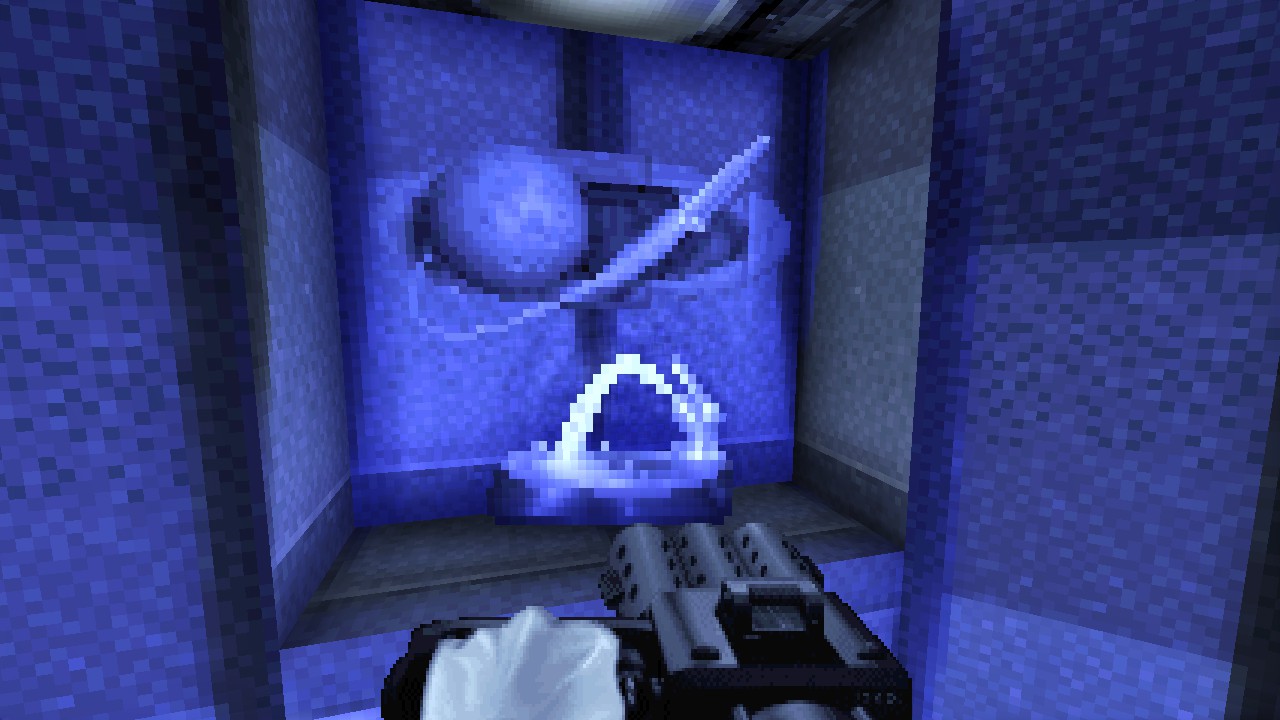
In addition the game featured some pretty nifty lighting for its time, featuring light switches that could dynamically light up an area and coloured lighting that directly affected the player's sprite and everything around it. The developers really made sure to push as much as they could out of the engine and it shows. The screenshots in this review are from the latest version of the game which is the 20th Anniversary World Tour edition and it's probably the best looking version of the game so far.

Sound-wise the game presents some pretty cool MIDI tracks (in modern source ports like the aforementioned World Tour edition these have been remastered as ogg files) that have more of a rock feel to them than Doom did. None of the tracks aside from the main theme can really be called memorable though and most fall into the category of being pretty much background music. And of course, Jon St. Jon's portrayal of Duke is now legendary with the game's many one-liners being classic quotes even today, so not a single bad word about his performance. Although his re-recorded lines in the World Tour edition does lack a bit of their original punch. The weapons all sound really cool, ranging from the beefy shotgun and peppering chaingun to the satisfying explosion sounds makes the game a joy for the ears.

Slurp. All space stations should have water fountains.
So a question remains, which version of Duke 3D should you get? Well, at the moment there is only a single version available and that is the World Tour edition. It comes with re-recorded lines from the Duke himself, improved graphics, as well as some rather lazy developer commentary (and most of it coming from Randy Pitchford himself, who isn't exactly popular among Duke fans nowadays), but for the most part is kind of lacking as it does not include the 3 expansions Duke It Out In DC, Nuclear Winter and Duke Carribbean: Life's A Beach. It does however include a new fourth episode which is worth playing. The earlier Megaton Edition did include these expansions and multiplayer but lacked some polish, especially on consoles, and the original DOS version was included as part of 3D Realms' Anthology pack but this pack has since been discontinued as well as the Megaton Edition, since Gearbox claims to own the IP and won't allow 3D Realms to release any of the original Duke Nukem games (which is highly ironic considering 3D Realms gave birth to the franchise...). So that's a kind of sad affair altogether. However due to how well the game has sold it's not hard finding physical copies online on places like eBay (which is where I bought my own boxed copy) and most of these physical copies work fine with DOSBox so however you obtain the game, it's definitely worth playing, cause even 22 years later, Duke Nukem 3D is still one of the most badass shooters in existence. I mean, it may seem a bit dated today but when this game came out, there was simply nothing like it.

Hail to the king, baby!

Stay tuned for part 2 of my Build Engine Retrospective where I'll be taking a look at what many consider the spiritual sequel to Duke 3D, namely Shadow Warrior!

STORY: 10/10
GAMEPLAY: 10/10
GRAPHICS: 10/10
SOUND: 8/10

TOTAL SCORE: 10/10

Friday, 30 March 2018

PC Game Review: Rad Rodgers


GAME: Rad Rodgers
DEVELOPER: Slipgate Studios
PUBLISHER: 3D Realms / THQ Nordic
YEAR: 2018

Rad Rodgers is the third game to come from Slipgate Studios, following in the wake of their 3D Realms revival with Rise Of The Triad 2013 and Bombshell, both made when they were called Interceptor Entertainment. After a name change and a deal with THQ Nordic, their newest game Rad Rodgers has finally been released for PC as well as XBox One and PS4. So having just completed it, I feel it's about time I give my thoughts on Slipgates' newest title.

Rad Rodgers is at heart an early 90's platformer made with today's technology, taking influence from a slew of games, including Apogee classics such as Cosmo's Cosmic Adventure and Commander Keen, and the Amiga classic Ruff'n'Tumble. It centers around the titular character, a young boy named Rad Rodgers (voiced by Hunter Pratt) who one evening after a lengthy session is sent to bed by his mother and immideately afterwards is sucked into his TV and finds not only is his game console Dusty (voiced by Jon St. Jon) alive, but he also has a pretty dirty sense of humor. The game quickly establishes its somewhat adult tone, similar to Conker's Bad Fur Day. And it makes it obvious that this game isn't marketed so much to kids as it's marketed to the people who grew up with these kinds of platformers and are more than old enough to handle foul language. The game does ship with a censor option though to bleep out the dirty words in case you want to spare your kids the worst of it.

World One in all its... overworld glory.
Anyway... back to the story. Apparently something has gone wrong in the game world and it's up to Rad and his pal Dusty to set things straight. Rad is immideately equipped a badass gun while Dusty helps out by smashing enemies with his arms and also has the power to enter rifts in the game's world that allows him to enter the "pixelverse", a world in which the game's very code can be changed and altered (kinda Matrix'y). And that's pretty much the only story the game has. What I love though is that it doesn't take itself too seriously, and has a lot of fun with its subject matter. All throughout the game there's a lot of banter between Rad and Dusty, a lot of it referencing pop culture but also establishing a bit of a brotherly vibe between the two (although Dusty is a bit more like that raunchy uncle who always tells dirty jokes at christmas parties). If crass humor is not your cup of tea, you might not be a big fan of the game but I found it pretty funny and I loved the personalities of Rad and Dusty and how they compliment each other. Rad being a child is pretty much either oblivious to Dusty's innuendo (which is proven by him staring awkwardly at the camera when Dusty makes a raunchy joke in the opening cutscene for the first level) or calls it gross. He always acts exactly how you'd expect a child to act and is even voiced by a real boy, making him feel like a pretty authentic character. His references are suitably "modern", spouting lines such as "git gud" and "do you even play?". At times he kinda sounds like those annoying 14-year olds you meet in Call of Duty but I suppose this was the intent. It never bothered me anyway. There's not a lot of story in the game but there is a ton of personality and unique humor.

The game features a "photo mode" which pauses the game and allows you to run the camera through the game world and take some pretty cinematic screenshots. Neato!
The game is probably one of the best platformers I've played in recent memory. Controls are incredibly tight (just how I like it...?) and the difficulty curve in the levels is just right with early levels being fairly easy and the last couple of levels being true challenges. In addition to your standard gun you also have powerups that give your gun special ammunition, including rapid fire, shooting phoenix-shaped fire blasts, lobbing grenades and firing a solid beam of death (can you say kamehameha?). The game also has three difficulty modes, with easy giving you endless lives and 4 hearts, with each heart pickup giving you 2 hearts, medium giving you 3 hearts (with heart pickups giving you 1 heart) and limited lives, and finally hard restricting you to 2 hearts (with heart pickups giving half a heart) and limited lives (which is the difficulty I used for this playthrough since I wanted a real challenge). It has to be said that the hard difficulty is probably what you should go with if you want an actual challenge as the game IS fairly easy all things considered (with the exception of the the last few levels which proved quite challenging).

Hats are a collectible in the game, each of them adding some variety to Rad's look (and even showing up in cutscenes).
One of the things I love the most about the game is how it truly feels like a 90's platformer that's been remade with modern graphics. The gameplay is consistently 2D and relies on classic and familiar traps and situations. It's very easy to feel at home in the game if you grew up with these kind of platformers. And if you have OCD then you might wanna look away from this game. The game not only contains a ton of secrets but also collectibles in the form of hats, hidden bonus coins and achievements for completing the levels 100% (grabbing all the gems and finding all the secrets as well as killing all enemies). The bonuses definitely feel like a callback to Duke Nukem where you'd get rewarded for killing all enemies in a level and such. I kinda wish there were more hidden bonuses but it's still a pretty fun experience and makes it worth replaying levels just to get that 100% score.

Slipgate has a bit of a track record for releasing buggy games but it's with a relief I can say that Rad Rodgers is probably the smoothest and most bug-free experience I've ever had from them. I didn't run into any serious glitches or bugs at all during my playthrough and overall had a really good time with the game.

Midlevel checkpoints take the form of floppy disks (with an accompanying floppy drive noise)
Graphically the game looks stunning. It has a very cartoony art style with a ton of colours and really good lighting effects (as to be expected from an UE4 game). At times the game does tend to look a little busy and it can make the levels a bit confusing at first but once you get into it, it becomes almost second nature to try and spot secrets in the levels which are fairly often very well clues. There's also a ton of little details and easter eggs in the level designs and since the cutscenes are rendered in real time, little details like the hat you're wearing will show up in them. I was able to run the game maxed out on my Phenom II 3.2 GHz PC with a 3GB R9 280X graphics card and getting a pretty decent framerate across the board (which speaks tons about how much the game has been optimized compared to the earlier "World One" version). You could definitely easily get a stable 60 FPS on a modern PC with this game even on maxed out settings.

The pixelverse, a sort of TRON-like world where you can interact with the game's code.
The sound is also really good with a few nitpicks we'll get to in a bit. First off I really wanna compliment the soundtrack. Andrew Hulshult has gone for more of a synthwave soundtrack with this game (reminiscent of games like Far Cry 3 Blood Dragon) mixed with his signature guitar solos and it really is a combination that works brilliantly and makes me wish he'd make more in this style. As opposed to his earlier outings with Bombshell the music in this game pops with really awesome melodies and riffs, heavy synthy basslines rumble in the background while his badass guitar solos are sprinkled on top. Definitely makes me want to listen to the soundtrack on its own. It's not as memorable as Giana Sisters, but it's definitely extremely pleasant to listen to and fits the game's whole retro vibe perfectly. The voice acting is also pretty great. Hunter Pratt voices Rad and using a real child actor as opposed to something like a female voice actor helps give Rad a very authentic sounding voice. He's of course not exactly a great actor and at times can sound a bit underwhelming but it can be forgiven given he's a child actor. Jon St Jon is also a ton of fun as Dusty and doing other minor voices in the game.
The sound design in general is pretty solid with the gun sounds and explosions being fairly satisfying. I do sort of miss more environmental sounds but what sounds are there do help keep you tuned in to what you need to pay attention to so too much noise might have worked against the sound's function.
I did run into some glitches with the sound though. Whenever I lowered the game's master volume, certain sounds would still play at full volume, more specifically the loading screen sound and the death sound of the larger enemies. Nothing too serious, but worth mentioning.

A pixelverse portal. The closer you get to these, the more the game will look corrupted and glitchy (a pretty neat effect).

All in all, Rad Rodgers is a beautiful love letter to the early 90's and at the same time feels fresh and has its own unique sense of humor that will definitely appeal to adults. If you grew up with PC platformers like Jazz Jackrabbit and Commander Keen, I highly recommend giving Rad Rodgers a try! My only real complaint so far is that the game is really short since only World One has been completed, but given they are working on the game I hope for World Two and Three soon enough! This is by far Slipgate Studios' best game so far and barring a few minor bugs the game is a thoroughly enjoyable experience in my opinion.

STORY: 8/10
GAMEPLAY: 9/10
GRAPHICS: 9/10
SOUND: 9/10

TOTAL SCORE: 9/10

Sunday, 25 March 2018

PC Game Review: The Curse Of Monkey Island


GAME: The Curse Of Monkey Island
DEVELOPER: LucasArts
PUBLISHER: LucasArts, Disney
YEAR: 1997


So for today's review, we're taking a look at arguably one of my favourite games ever. The Curse Of Monkey Island (commonly shortened to CMI) is the third game in the amazing Monkey Island adventure game series, and in my opinion the one that I consider the best. It was the first game not to be written by Ron Gilbert and while this does make the tone somewhat different from the first two games, in some ways this helps it feel more like its own thing as well. It was also the first game to be released for Windows exclusively as the first two games were released for DOS (and Amiga if I remember correctly).

The game starts off "somewhere in the Caribbean" and we're witnessing a somewhat distressed (and starving) Guybrush Threepwood sailing the sea in a bumper car. He's writing his Captain's log, complaining about lack of fresh water and food (while humorously he is too busy writing about wanting these things to notice they are floating right behind him...) when the sounds of cannon fire breaks him out of his thoughts and he finds himself on the shores of Plunder Island. A battle between LeChuck and governor Elaine Marley ensues with Guybrush becoming trapped in LeChuck's hold. After managing to both (somewhat anticlimatically) defeat LeChuck and escape from his capsized ship within the first part of the game, he meets up with Elaine on the shore and promptly asks her to marry him with an engagement ring he found in LeChuck's treasure hold. However, turns out the ring is cursed (which in Guybrush' defense he had no idea about) and Elaine is turned into a gold statue.So good news is she's solid gold and practically nothing could really happen to her. Bad news is she's solid gold and some pirates have stolen her. Your goal becomes to undo the curse on Elaine as your adventure takes you from Plunder Island across the seas to Blood Island where an engagement ring equal to the cursed ring is located, which you will need to replace the cursed ring with. Of course, all this info is relayed to you by the awesome Voodoo Lady from the older games who despite her short time in the game is one of the strongest characters in the game in terms of impression (if only cause she has a meat-flavoured gumball machine in her place).


Mandatory shameless plug for other Lucas Arts games comes in the form of a Manny Calavera cameo and a button that says "Ask me about Grim Fandango"

So that's pretty much all I wanna spoil about the main story since I honestly feel this is a game worth playing so I'll try to keep any further spoilers to a minimum. What I love the most about CMI is the humor though. Most of it ranges from witty and clever jokes to pretty much lough out loud moments. I mean, this game is funny, and if it doesn't make you at least gigglefit a couple times, I have no idea what will. And I find this makes the game a lot easier to play since the dialogue is so funny that you kinda wanna hear as much of it as possible while playing which kind of ensures you never miss any important hints. The writing is some of the best in any Lucas Arts game I've played, with a few references here and there to Star Wars thrown in for good measure.
A good example of the game's humor would be when Haggis McMutton (who's voiced by the late Alan Young of Scrooge McDuck fame) explains the origins of his name to you and tells you his given name was "Heart Liver and Kidneys Boiled in the Stomach of the Animal McMutton" and Guybrush responds "so your parents were expecting a girl." Or when you find out the origins of the name for Skull Island (which I won't spoil but it had me laughing so hard the first time I saw it).

What I love the most about CMI is the meticulate attention to detail the designers obviously have and how game mechanics are woven into the game's world so well that most of the time you don't even notice it. The game is chock full of little details and funny "in-jokes" that gives the game a ton of charm and personality. Whether it'd be from all the plaques scattered throughout the game, which granted is a purely mechanical way of giving the player hints but it also doesn't come off that way given it makes sense someone would put up a plaque to inform others of what something is, the fact that the clocktower on Plunder Island actually legit shows the time as it follows your system clock, or the fact if you read a plaque about the Pappapishu plant and learn the origin of its name, every character from that point on will say Pappapishu instead of "ouch". It's clear that the people who worked on this game had fun with the game's setting and put as much into it as possible to help make it memorable and interesting in addition to making it a funny and lively place. Nothing in the game feels outright threatening, there's ALWAYS a sense of fun beneath all of it, even during the darker parts of the game you get the feeling this is all in good fun and that comforting and inviting feeling about this game makes it so hard to put down, and makes it so relaxing to play. The characters are so incredibly well written in this game, whether it'll be Murray the talking skull and his craving for world domination despite being just a skull, the washed up actor Slappy Cromwell who rewrote Shakespeare to appease pirates or any of the other side characters in this game that never feel like side characters but proper characters who live in this universe.

The zombie pirate LeChuck who undergoes a bit of a transformation in the game, becoming... slightly more dead I suppose.

The most brilliant thing about the game, which also counts for pretty much all Lucas Arts games of the time, is that the puzzles are designed in such a way that it's impossible for you to get softlocked in the game and you'll never find yourself in a state where you can't proceed cause you missed an item or important piece of information, something that makes the game still really playable today. For instance, something I never really thought about but noticed while playing the game was that during a puzzle where you are trapped in quicksand you need to attach a rock to a balloon in order to drop it on a vine that will get you out of the quicksand. It's impossible for you to be stuck in the quicksand without the rock in your inventory since in order to get to the quicksand in the first place you need scissors to cut through some undergrowth. You acquire both things before you get there, but it's impossible to acquire the scissors without first acquiring the rock due to how that earlier puzzle is designed. It's this kind of really well thought puzzle design that permeates the entire game and most of the time you don't even notice it because the puzzles are so well done, just like the example I just mentioned. To this day I consider LucasArts some of the best designed adventure games ever and this is the exact reason why. Of course, it's also impossible to die in LucasArts games, which makes it incredibly hilarious that at one point in CMI you actually have to die to progress, though you do so by faking it so while it doesn't really count I find it hilarious that you have to actually do something that's pretty much impossible in LucasArts adventures (except the first game where you could actually die but it was in a single instance).

There's something familiar about that face...
The controls are pretty much as intuitive as you'd expect. Forgoing the classic SCUMM interface of the first two games, the game instead uses a much more simple "coin" which you can access by holding down the mouse button on objects. This coin contains three context-sensitive icons: The hand symbol allows you to physically interact with things, either pushing, opening or otherwise do things with your hands (no... not that...). The eye symbol allows you to examine things or look through things, generally use your face. The last is the mouth symbol, which for the most part is used for talking to people but can also be used for eating stuff or generally interacting with your mouth (again... not that...). It's an incredibly intuitive interface that was also used for similar games of the time period like The Longest Journey (another one of my all-time favourites) and Day Of The Tentacle. And trying out all 3 options on things can often lead to some funny lines, which makes it incredibly fun to just interact with things in the game, which is good considering that's what you do most of the time.

The game's graphical style is also incredibly good. While it's pretty different from the more realistic drawing style of the first two games and goes for a more cartoony style I think it really fits the game's atmosphere and helps give it a very distinct mood that you probably couldn't get otherwise. The characters all have really expressive animations and the background art is stunning at times with really well done colouring. At times it feels like you're pretty much playing a classic cartoon and I absolutely love every bit of it. Of course playing the game nowadays does make it feel somewhat low-res and I really REALLY wish there was an HD remake of the game similar to Grim Fandango Remastered with remastered artwork in high definition, much like the HD remasters of the first two games. But the game's artwork is still some of the best in the franchise in my opinion. I especially love the design of Guybrush who has a more lanky appearance in this game compared to the first two.

And the sound... good god I cannot praise the sound of this game enough. The voice acting is frankly superb and I love how much personality the voice actors add to the characters. My favourite has to be Dominic Armato who voices Guybrush for the first time in the series (although he did go on to voice him in the HD remasters of the first two games as well). His comedic timing is so spot on it hurts and his voice is now so synonymous with the character I can't even imagine anyone else voicing him in all honesty. He has this somewhat clumsy feel to him, but never mean-spirited and he really does come across as a well-meaning but unlucky (and unlikely) hero most of the time. Elaine is also voiced perfectly by Alexandra Boyd and it's a real shame she's pretty much quiet for most of the game. And of course, Alan Young has to be mentioned here, giving a really memorable performance as the Scotsman Haggis McMutton (and if you're going to have a Scotsman in the game, there's honestly no better Scotsman than Alan Young to voice him if you ask me). Everyone else are also doing an amazing job and the voice acting is one of the strongest aspects about the game, especially the Voodoo Lady who's voice alone helps give her an even greater impact than in the previous games (despite her short appearance).

This is what you get for recruiting a barbershop quartet as your crew, Guybrush...
And I don't think there's enough superlatives to say how much I love the music. It ranges from reggae influenced Caribbean music with plenty of steel drums and organs (which is perfect given the Caribbean setting) to cinematic mood pieces. All of it perfectly fits the scene it's in, helps give the game a ton of atmosphere and personality, and much like Grim Fandango's score has a style that perfectly matches the game's setting and it's impossible to imagine the game without it. Also, this game's rendition of the series' signature theme is probably my favourite of the entire franchise and when the theme hits during the opening credits I get goosebumps every time. It's honestly one of the best themes ever made for a video game.


I could honestly gush for hours about this game and how much I love it and it's a struggle keeping this review short enough, but in all honesty if you've never played this game you need to. I cannot recommend it enough, it is one of the best of its genre and much like other adventure games like Grim Fandango and The Longest Journey, the games that came out during this time were some of the best ever even if they underperformed in sales. The game feels like its own little universe, breathing and popping out of the screen with its quirky and memorable characters, its insanely funny humor and clever writing and insanely good puzzles. If you're going to play an adventure game today, I suggest starting with this. I don't see how I could give this game anything but a perfect score as in my eyes, there's been few games as good and fun as Curse. It's on Steam now for a price that's practically a steal, so what ye be waitin' for? The sea be waitin' for some good old insult sword fighting!

STORY: 10/10
GAMEPLAY: 10/10
GRAPHICS: 10/10
SOUND: 10/10
TOTAL SCORE: 10/10!

Tuesday, 20 March 2018

PC Game Review: Deus Ex


GAME: Deus Ex
DEVELOPER: Ion Storm
PUBLISHER: Eidos Interactive
RELEASED: 2000


Okay, so I'm down with a cold and taking a short break from playing Rad Rodgers in order to take a look at a pretty special game. Where Doom and Quake can be considered the grandfathers of the first person shooter genre, Deus Ex can really be considered one of the grandfathers of the stealth shooter genre and has spawned one sequel and two prequels. So there really isn't much to be said about the game which hasn't been said already. But I'm gonna try my best to give my own unique perspective on this in this retrospective review of one of the greatest first person stealth cyberpunk RPG's of all time.

I don't really remember the first time I played Deus Ex, but I think it was somewhere around 2001-2002. And I don't really remember much of the experience, other than the fact I thought Jaime Reyes looked and sounded an awful lot like my dad (which gave me a kind of weird family relationship with the character), but beyond that it was never a game I completely understood. I mostly messed around with cheat codes to give myself god mode, all augmentations and a crapload of skills and just going through it like an overpowered dick. Of course later on I discovered that wasn't really that fun and not really the point of the game, even though I originally completed the game that way.

The game was primarily designed and conceptualized by Warren Spector, who up until the development of Deus Ex had worked with Looking Glass Studios who famously developed System Shock, System Shock 2 as well as the Thief games and it's easy to see Deus Ex being a bit of a logical evolution of those games. Although it feels a lot more balanced in terms of gameplay, focusing more on giving players a set of options on how to complete a level, which is what was really groundbreaking about it. Meaning there was never a wrong way to play the game, and how the player approached each mission could vary depending on their playstyle and chosen skillset. It's a game more about roleplaying and choosing your own approach, rather than going along with whatever approach the developer might intend, which is what truly sets it apart from other stealth games of its day such as Metal Gear Solid, where there was a bigger emphasis on a certain playstyle, while Deus Ex is more open to a variety of playstyles. There is nothing stopping you from killing every single enemy in a level, though the game will change depending on your actions, as everything you do invariably has consequences, which was the most groundbreaking thing about the game. For instance it is possible to go through the entire game without killing a single NPC by hand (the bosses are required to be taken out but you can do so without touching them). Of course doing so is very difficult and will require some ingenuity, but just the fact it is possible speaks volumes about how focused Deus Ex is on player freedom. Of course this doesn't mean the game won't punish you for doing pretty stupid things, but it does so in a very believable way. The game seems very focused on making its world believable and everyone around you will act in a very realistic and believable manner, so whenever you do something stupid and have to take the consequences for it, it feels more like the world reacting to you and less like the game trying to punish you.

*insert Benny Hill theme here*
The story in Deus Ex starts off simple enough. You're a fresh recruit off the academy, part of a new breed of soldiers who are augmented with nanobots in their blood stream that allow them access to superhuman abilities, such as regenerating health, lights from their eyes, increased jump height and so on. Due to the reliance on nanomachines to do all the work, these new prototypes are considered the evolution of mankind, and a generation above the "mechs", the more typical mechanically augmented human commonly associated with cyberpunk. Your name is J.C. Denton, and your first assignment is on Liberty Island, where a group of terrorists (the NSF) have taken over the island and your task is to sneak into the Statue of Liberty and interrogate the NSF leader about the shipment of Ambrosia, a vaccine that is the only known cure for a plague that has struck the nation, the Grey Death. Acquiring the location, which happens to be an underground bunker below Castle Clinton in Battery Park, you head there with your assigned partner, Anna Navarre in what can only be described as a buddy cop setup if I ever saw one, seeing as Anna Navarre is one of the older mechs who have a lot of resentment for the newer nano augmented agents, but is still willing to give you the benefit of the doubt if you can manage to impress her. Once you have located the ambrosia you are sent to Hell's Kitchen to locate a warehouse to blow up the NSF' power generator. When you get back from the mission, your brother has disappeared and you are tasked with going to an airfield to eliminate one of the terrorist leaders, Juan Lebedev as well as securing the remaining shipment of Ambrosia. However when you get there, things take a big change. Your brother Paul reveals he's working with the NSF to uncover a conspiracy within the government, convinced that the Grey Death is a man made virus. And if you allow Juan Lebedev to live long enough to talk, he will inform you that you and your brother are part of this conspiracy, as you were bio-engineered from birth to accept nanomachines into your body. Regardless of whether he lives or dies, before you can travel to Hong Kong to assassinate a triad leader, your helicopter pilot brings you back to Hell's Kitchen where your brother reveals he is dying. A kill switch has been enabled and he will be dead within 24 hours.

And that's all I wanna spoil for you. While the story does get a little convoluted, especially later on, it is incredibly engaging and despite the at times cringeworthy voice acting, it is an incredibly big story involving conspiracies, AI's, aliens and pretty much anything you can think of that wouldn't be out of place in an episode of the X-Files. While Deus Ex is pretty much a product of the late 90's with its Matrix-influenced protagonist and gritty realistic portrayal of the near future, it still feels pretty relevant today and I honestly find it a more believable portrayal of the future than a lot of cyberpunk games, if only cause it feels so rooted in reality.

Welcome to China, where the military carry fucking flamethrowers...
When Deus Ex came out there weren't really anything that could compare to its gameplay. The closest comparison would obviously be System Shock 2 which featured a similar gameplay system, but where System Shock 2 was more of a cult hit and a critical darling that never really found a mainstream audience, Deus Ex immideately became a best seller. And it is fairly easy to see why. It ditches some of the more cumbersome features from the System Shock games and streamlines a lot of them without dumbing it down.

The augmentation system is fairly easy to grasp. You have basically slots for different parts of your body that can be augmented and using these augmentations is accessible via the F3-F12 keys on your keyboard. You can find augmentations in the form of canisters (most of them hidden in hard to reach places), each containing 2 augmentations, forcing you to choose between the two as once installed, an augmentation is permanently embedded in your system and irreplacable. The RPG elements come into play via skill points that can be spent upgrading various abilities, everything from how good you are with weapon groups to hacking computers and using lockpicks. Skill points are rewarded fairly sparse and coupled with the permanent nature of augmentations, it's generally a good idea to pick a playstyle you wanna go for and sticking to it (you know, actually roleplaying). It is a bit of an oldschool mentality and this strict enforcement was either more relaxed or removed entirely in future installments.

Combat feels a little janky. It's hard to describe but movement can feel a little clunky at times, and it's clear the game wasn't really designed to be a shooter first and foremost. What I would often end up doing was sneaking up to enemies and taking them out, then moving their bodies to a hidden spot, or sniping them from afar with a rifle. Weapons can also be upgraded with weapon mods that add laser sights, silencers and increase range, accuracy and reload speed. Some mods might not be compatible with certain weapons, such as in the fact you can't add a silencer to a rocket launcher (as tempting as it would be).

Not sure what a wine bottle is doing in this cell.
Graphically the game hasn't really held up that well. Models in particular have a fairly low texture resolution and the animations can come off as a bit janky. But on the plus side, it runs on the early Unreal engine which features the classic detailed textures, meaning that certain wall textures will look really detailed up close, and the animations are generally fairly decent for the time. Using modern mods can offer texture replacements with high resolution graphics and new models for the characters, though I much prefer the original graphics. The game takes place pretty much entirely at night time, giving it a very unique atmosphere where you never see sunlight in the entire game (which is ironic considering J.C. wears his sunglasses the entire time).

The soundtrack is legendary of course. Alexander Brandon who also worked on Jazz Jackrabbit 2 did a fair bit of it and it's all really well done. It uses the tracker format that was also used in games like Unreal Tournament, and it gives it a very unique feel. Pretty much all of the tracks are really memorable and add to the game's atmosphere, and it's impossible to imagine the game without them. And as mention the voice acting can be hit or miss. It ranges from badass to almost so bad it's good territory...

Talk about hitting the wall.
That being said, Deus Ex is an amazing experience and has held up remarkably well. There is a saying that every time someone mentions Deus Ex, someone reinstalls it and I've been guilty of that on more than one occasion. The world is incredibly dense and rich with interesting characters that all act realistically to your actions and everything you do affects the game in some way. There's immense replay value to the game and to this day I still keep finding new stuff in the game whenever I play it. It's by no means a perfect game, but it is a true classic and one everyone should play at least once. Because it is impossible to imagine modern gaming without Deus Ex as its unique blend of gameplay styles created a genre all of its own. And its dark cyberpunk atmosphere draws you in again and again. And whether you play the original, or one of the various mods (including the extremely impressive Revision mod), Deus Ex is a must-play if you enjoy this genre of games.

STORY: 8/10
GAMEPLAY: 8/10
GRAPHICS: 7/10

SOUND: 8/10

TOTAL SCORE: 8/10